
How to Stop Clenching Your Jaw - Call “Emma”
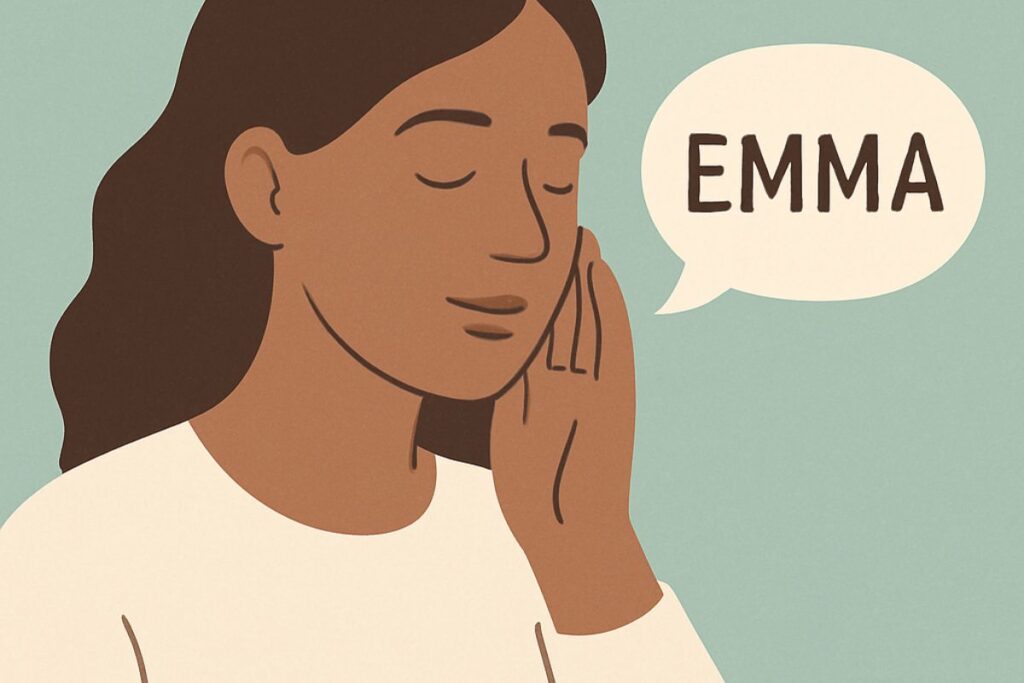
Are you aware that you are clenching during the day as well as at night? Maybe you sometimes catch yourself with your molars firmly jammed together?
Jaw clenching — sometimes called bruxism — is one of the most common reasons people develop jaw tension.
In my experience, if you can stop clenching during the day, there’s a much better chance you’ll carry that habit into your sleep — and you’re less likely to clench at night.
I share this exercise with all my clients who clench during the day. For many, it is a complete game changer. See how it works for you.
I’m going to explain how to unclench your jaw during the day, and then how to have your tongue in the best position to stabilise the jaw and relax the jaw muscles.
When you feel yourself clenching — Call “Emma”
Calling Emma is an easy way to remember this exercise. “My jaw is clenched. I know, I’ll call Emma.”
Here’s how it works.
You can’t really clench your jaw while making the sound “ah” at the end of the word “Emma”.
Saying “Emma” gently creates a brief, unavoidable release of the clench — without forcing the jaw open or trying to relax it.
I suggest softly calling “Emma” three times.
On the M, your lips come together. On the ah, your teeth have to part. After the third Emma, stay on the A — bring your lips softly together but keep your teeth apart. Then bring your tongue to the roof of your mouth and allow it to rest just behind your upper teeth.
Placing the tongue in this stable resting position afterwards helps organise the jaw safely, with the teeth remaining apart.
You have now relaxed the jaw. The more you can stay in that soft, stable position — the more safe the body will feel and the more relaxed the jaw will become over time.
That’s it. Your jaw was clenched. You’ve called Emma, relaxed the jaw and stabilised it.
Can you do it wrong?
Possibly. It helps to think about why we’re doing it. The body is in tension. We want the jaw to let go. So, with that in mind, if we aggressively bark “Emma” it’s not going to be conducive to letting things go. So, just think about the intent and softly call “Emma” to help relax the jaw.
Is this all you need to do to release jaw tension?
No. This is one of the tools you may consider adding to your toolkit. And as with all the tools in your toolkit, I’d recommend you use it for at least two weeks before you make any judgement.
If after two weeks you think it’s really helping — your symptoms are reducing, your jaw feels calmer — then keep it. If you think it’s doing nothing at all, by all means dump the exercise.
Just on this note, I do recommend that you take charge of everything you do in terms of self-care. This is your body. You’re trying to work out what it’s saying to you. And this is one exercise that I have witnessed playing a key role in assuring the nervous system that it is safe to let go of jaw tension.
This exercise was shared by Leslie Russek, DPT, PhD, on the Bendy Bodies podcast (Episode 52: “Unlocking Jaw Pain”).
Want to explore further?
If you’d like to understand more about why the tongue’s resting position matters for jaw tension, or explore other practical approaches like self-massage for TMJ symptoms, you can find these in the Jaw Care Library.

Written by
Steven Murdoch
TMJ specialist and musculoskeletal pain-care therapist based in London. CNHC registered · Trained at Jing (BTEC Level 6) and with Helen Baker at TMJ Massage Therapies.
About Steven →You May Find These Guides Helpful
Looking for something else?
When to Seek Medical Advice
Most jaw tension and TMD symptoms are related to muscle guarding, stress, or nervous-system patterns, and they often improve well with gentle self-care.
It’s a good idea to seek medical advice if you experience:
sudden, severe, or unexplained facial or jaw pain
injury, swelling, or suspected dislocation
numbness, weakness, or changes in vision or speech
a fever, illness, or signs of infection
new pain accompanied by weight loss or general unwellness
persistent symptoms that worry you or don’t improve over time
These situations aren’t common, but it’s always appropriate to check in with a qualified medical professional if something feels unusual or concerning for you.