
3 Natural Ways to Reduce Teeth Grinding During Sleep
It’s hard to find good advice on how to stop teeth grinding at night (sleep bruxism). Most research focuses on managing the symptoms rather than understanding what might actually be causing nighttime clenching.
For this reason a lot of advice tends to explore the use of night guards or botox injections — but neither may be that effective at solving the problem.
With a 2024 global study suggesting that around one in five people grind their teeth at night, that is a lot of people who are likely struggling to find a long-term solution to reducing or stopping their nighttime teeth grinding.
In this article I am going to suggest 3 natural ways to reduce teeth grinding during sleep. These are exactly the exercises I recommend to my own clients. Before we look at them however, what of night guards and botox injections? How effective are they?
Do Night Guards Stop Teeth Grinding at Night?
Night guards are often one of the first recommendations by dentists. A significant 2022 systematic review of 1,499 research articles titled: Therapies for sleep bruxism in dentistry found confusing results for their effectiveness at reducing sleep bruxism.
Standard guards were found to give some benefit in reducing grinding. Interestingly they were shown to be more effective if not worn every night. Guards aimed at repositioning the jaw were shown to often aggravate TMJ symptoms. So much so that in one study, a quarter of participants had to stop using them.
This is similar to what I hear from my own clients. Many started with a soft guard and then progressed to a harder guard. It is that change to the harder guard that is often the start of or the worsening of jaw tension.
Similarly, I see the same with splints aimed at repositioning. And it’s unsurprising. I can’t imagine the nervous system being overly happy — either with a hard object in the mouth during sleep, or with the jaw being cajoled into a different position.
Do Botox Injections Reduce Nighttime Teeth Grinding?
The same study found that the use of botox for sleep bruxism was inconclusive. Of three major trials, the first showed botox did outperform a placebo, but the second showed it performed the same as a placebo, and the third found no significant difference — either with botox or a placebo.
Unsurprisingly, the systematic review concluded that treatment should not be focused on sleep bruxism as such, but on investigating the factors that led to its onset.
What causes sleep bruxism?
Research into the causes of sleep bruxism often find that the nervous system plays a significant role.
A 2024 review, “Bruxism: A comprehensive review of its pathophysiology and management”, describes how chronic stress may affect brain pathways involved in muscle activity and arousal. This can increase activation in regions linked to jaw movement, helping explain why the body may continue to clench or grind during sleep, even when there is no problem in the jaw itself.
So it is refreshing to see articles such as this one in the Guardian: Do you grind your teeth at night? Here’s what to do. It is well researched and ends with some helpful advice, after acknowledging that nightguards won’t stop the grinding:
Good sleep hygiene and behavioral adjustments, a regular schedule, limiting caffeine, and creating a calm sleep environment. Their expert also suggests relaxation techniques and cognitive behavioral therapy.
3 Natural Ways to Reduce Teeth Grinding During Sleep
Talking therapies aren’t for everyone though. And in my experience, there is a lot we can do to reduce nighttime grinding ourselves at home. Here are three simple things you may want to explore which I recommend regularly to my TMJ clients. All three are based on working with the nervous system rather than against it.
1. Unclench Your Jaw — The Emma Exercise
This is a great way to encourage the jaw to stay in a relaxed, unclenched position.
Say the word “Emma” softly, three times. On the M, your lips come together. On the A, your teeth have to part. You can’t clench while making that sound — it bypasses the nervous system’s grip without any force at all.
After the third Emma, stay on the A. Bring your lips softly together, keep the teeth apart, and rest your tongue gently on the roof of your mouth, just behind your upper teeth. That’s a stable, safe position for the jaw to be in.
If you can reduce daytime clenching, there’s a much better chance that pattern carries into sleep.
2. Vagus Nerve Massage
The vagus nerve is the longest nerve in the body, and it directly supplies the muscles responsible for chewing and jaw movement. It’s the primary switch between “fight or flight” and “rest and digest.” When the system is in the “fight or flight” state, that’s when teeth grinding can happen.
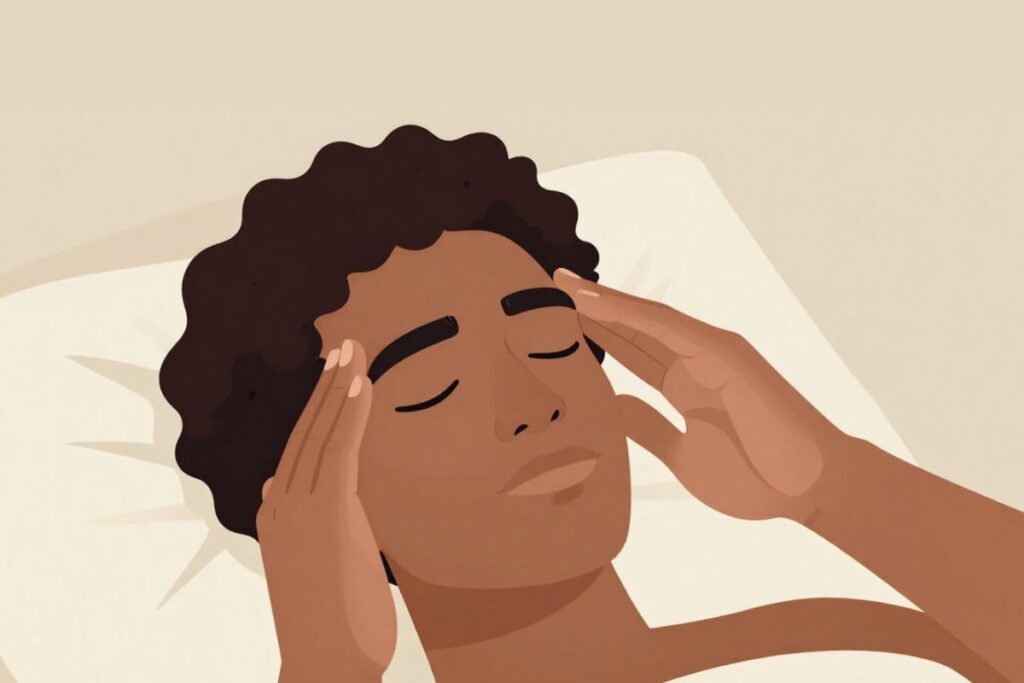
Lightly massaging the temporal area — the soft space at the side of your head, just beside your eyes — can stimulate the vagus nerve and signal to the system that it’s safe. Some people feel an immediate sense of warmth or ease. Others notice the jaw softening gradually over time.
Research supports this — a randomised controlled study found that vagus nerve stimulation significantly reduced pain sensitivity in women with TMD-related jaw pain.
Vagus nerve massage is great to do as part of your nighttime routine — the last thing to do at night — signalling it’s time to sleep.
3. Release Neck Tension
Neck tension and teeth grinding often go hand in hand. The jaw, neck, and head share muscles, connective tissue, and workload — when one tightens, the others follow.
Rather than stretching the neck, which can provoke the same protective tightening, this approach uses positional release — a technique where you find the position of most ease and hold it there. Within 20 to 60 seconds, the nervous system can begin to register that the area is safe, and the tissue may start to soften on its own.
Many of my clients find this produces an immediate, noticeable change — both in the neck and in the jaw. If you also get headaches alongside your jaw tension, this is well worth trying.
You May Find These Guides Helpful
Looking for something else?
When to Seek Medical Advice
Most jaw tension and TMD symptoms are related to muscle guarding, stress, or nervous-system patterns, and they often improve well with gentle self-care.
It’s a good idea to seek medical advice if you experience:
sudden, severe, or unexplained facial or jaw pain
injury, swelling, or suspected dislocation
numbness, weakness, or changes in vision or speech
a fever, illness, or signs of infection
new pain accompanied by weight loss or general unwellness
persistent symptoms that worry you or don’t improve over time
These situations aren’t common, but it’s always appropriate to check in with a qualified medical professional if something feels unusual or concerning for you.